Next Chandrayaan-3 mission on the moon
Next for India’s Chandrayaan-3 mission on the moon of irso.
The primary mission to land close to the lunar south pole is supposed to continue onward until the sun sets on the moon fourteen days from now.
The dark soil of the moon should be visible close to a leg of a space apparatus
India’s Chandrayaan-3 mission snapped this picture of the lunar surface soon after arriving on the moon on Aug. 23, 2023.
The moon’s south polar locale has invited its absolute first guest.
Regardless of the various holes and channels that scar the area, India’s automated Chandrayaan-3 shuttle contacted down delicately as planned yesterday (Aug. 23) in its moderately level landing spot between the Manzinus C and Simpelius N holes, situated around 70 degrees from the moon’s south pole.
The rocket’s drive unit, a container molded module that had carried Chandrayaan-3’s lander-wanderer couple into a tight circle around the moon and isolated from it before the arrival, keeps on surrounding Earth’s closest neighbor. The module is furnished with just a single logical instrument, named SHAPE (Spectro-polarimetry of Livable Planet Earth), which is intended to concentrate on Earth from lunar circle, as a result emulating perceptions of a far off exoplanet.
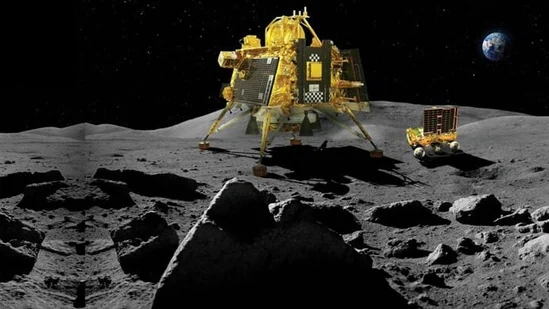
The vast majority of the world’s consideration, in any case, is on the moon’s surface. Soon after the lander Vikram landed on the moon, it laid out correspondences with mission control in Bengaluru, India, as per the Indian Space Exploration Association (ISRO).Furthermore, the space organization reported late yesterday on X (previously Twitter) that the wanderer, Pragyan, effectively moved off the lander through a short slope and “went for a stroll on the moon.” That implies the meanderer effectively conveyed its own small sun powered chargers to assist it with crawling forward. It has two spectrometers locally available to concentrate on the cosmetics of lunar soil in the quick region around the arrival site.
Albeit the meanderer is outfitted with cameras to stay away from impediments, its developments will be controlled consistently to such an extent that it walks inside the field of perspective on the cameras on the lander Vikram, ISRO has recently said.
Vikram likewise turned on three of today four locally available science tests (Aug. 24), as indicated by ISRO. An especially fascinating instrument is a warm test that will, interestingly, shallowly test lunar soil and measure its temperature, among different properties.
A second Vikram instrument will concentrate on a layer of the moon’s dubious climate known as the ionosphere, which is loaded up with electrons and particles framed to a great extent because of sun based radiation. Researchers say this test will assist with deciding if the ionosphere is minimally pressed consistently or on the other hand assuming its thickness changes after some time and differing daylight conditions.
The third examination is a seismometer that will detect moonquakes close to the arrival site, while the fourth payload is an inactive laser retroreflector cluster by NASA to “grasp the elements of the moon framework.”
Researchers are anxious to gather as much science as possible in the following fourteen days, on the grounds that neither the lander nor the meanderer is intended to endure a severe night on the moon, when polar temperatures decrease to short 382 degrees Fahrenheit (less 230 degrees Celsius). or on the other hand less.
So when shadows overwhelm the lander Vikram and wanderer Pragyan after the sun sets, it won’t be a shock in the event that they go incommunicado